
What a Boulder Resident Lookup Covers
A Boulder resident lookup is a chain of narrow questions, not one universal name file. The assessor can connect a name to a parcel and an owner mailing address. GoVote can test a current registration match when the name, ZIP, and full birthday are known. Court, vital, historical, business, and license records answer different questions and carry different access rules.
| Record | What It Confirms | Where | Access |
|---|---|---|---|
| Assessor parcel and tax roll | Recorded owner, parcel situs, owner mailing address, and account context | Boulder County Assessor Property Search and daily CSV | Public current property fields; no household roster |
| Recorded deed or document | Grantor, grantee, recorded date, legal description, and instrument references | Boulder County PublicSearch quick or advanced search | Free index and watermarked view; copies and certification cost more |
| Voter registration lookup | One registration match, status, and public fields if the result returns them | Colorado GoVote | First, last, ZIP, and birthday required; protected records are absent |
| Voter data products | Time-stamped address, status, party, precinct, and participation fields | Boulder Elections and Colorado Secretary of State request routes | Product fees, certifications, windows, and exclusions apply |
| Court docket | Party lead, case number, hearing date, type, place, and appearance details | Colorado Judicial Branch docket, county 7 | Calendar and index access; full files may require a request |
| Court document request | ROA, order, decree, judgment, probate paper, or certified document | Boulder Combined Court clerk and request form | Fees, ID, party status, and protected-file rules apply |
| Birth, death, marriage, or divorce | Eligible event or court-file evidence | Boulder Public Health, Clerk and Recorder, CDPHE, or district court | Confidential under Colorado rules; eligibility and ID are required |
| Historical collections | Past address, family, death, burial, business, or civic connection | Carnegie Local History, BGS, newspapers, directories, and cemetery sources | Indexes and scans are leads; shelf or archive access varies |
| Business or license filing | Public entity, trade-name, credential, or location affiliation | Colorado SOS, DORA MyLicense, and city license layers | Current public fields vary by result and board |
Start with the source that matches the fact being checked. For a Boulder resident lookup, an address question belongs with the assessor and parcel map. A registration question belongs with GoVote. A family event needs the issuing office, while a former resident may require Carnegie, BGS, a newspaper page, or a cemetery cross-reference. Keep the record date, search terms, and custodian together so a later match does not blur into a different person.
Online access has practical fallbacks. Boulder County Recording works from its 1750 33rd Street office Monday through Thursday, 7:30 to 5:00, and takes phone or mail copy requests; the recording line is 303-413-7770. The Assessor has a public counter at 1325 Pearl Street and a 303-441-3530 line, while the county GIS map and daily data downloads support a first pass. For a county-held record with no ordinary portal, use the county’s CORA request channel.
Colorado GoVote for Boulder Residents
The Colorado GoVote form is a one-person match tool. It requires First, Last, ZIP, and Birthday in MM/DD/YYYY format. If a person moved, the state page advises trying the previous ZIP. A failure to locate a record can reflect a changed registration, a spelling error, a different jurisdiction, a confidential voter, or a preregistered person under 18. Contact Boulder County Elections when a current registration question cannot be resolved from the form.
Public voter fields described by the Colorado Secretary of State include full name, residential address, party or affiliation and its date, registration status, birth year, phone if provided, gender if provided, and whether the person voted in a prior election. The public record does not show a ballot choice. Social Security number, driver-license number, month and day of birth, signature, email, and protected-voter information are withheld.
- VR-011B: Voter ID, name, residential and mailing address, phone, registration and effective dates, party, status, ID-required flag, gender, and birth year; issued monthly by the first day.
- CE-068: voter identity, address, precinct, vote method, ballot sent or received, voted party, in-person date, and issuing location; available from 22 days before an election through 10 days after.
- EX-002: election history with election type, date, method, party, county, registration, address, status, precinct, and district fields; issued monthly.
- CE-077: rejected or cure data with name, birth year, party, phone, address, mail activity, and rejection reason; available hourly from 19 days before an election through day 8 after.
Boulder Elections handles the county product route at 1750 33rd Street, Suite 200, Boulder, with 303-413-7740 and vote@bouldercounty.gov. The state request form has requestor, organization, address, phone, email, product, date, payment, and certification fields, and the Colorado Elections Division can be reached at 1700 Broadway, Suite 550, Denver, 303-894-2200, or elections@coloradosos.gov. County instructions say CORA is not the route for these datasets. Product access can carry a $1,000 subscription price or $50 individual-report prices, so confirm the current fee page before ordering.
Note: Boulder’s 2024 active count was 68,342 in the location row and 235,603 countywide, a scale measure rather than a street roster.
Boulder Court Dockets and Name Matches
Colorado’s statewide docket uses county=7 for Boulder. The inspected Boulder-filtered snapshot showed 59 results, with date, time, duration, name or party display, case number, hearing type, location, appearance, and courtroom. Search controls include judicial district, county, courthouse, court type, division, date range, specified date, case year, case class, case sequence, party type, first and last name, business name, and attorney name or bar number. At least one filter besides date is required.
The Colorado Judicial Branch docket is a hearing calendar and public index, not the complete case file. A result can lead to a case number and filing context, but it does not necessarily show a complaint, exhibit, judgment, or full register of actions. A Boulder resident lookup that reaches a court row still needs the clerk-held case record and identity checks. Public courthouse terminals and the clerk counter remain the fallback for older or absent web results. Boulder Combined Court serves Boulder and Longmont; the Boulder courthouse is at 1777 6th Street, and the records email is 20recordsrequest@judicial.state.co.us. City traffic, parking, animal, photo, and misdemeanor matters follow Boulder Municipal Court records at 303-441-1841, while federal matters use PACER.
The Colorado Judicial Branch record and document request form shows the fields needed to move from a name lead to a held document.
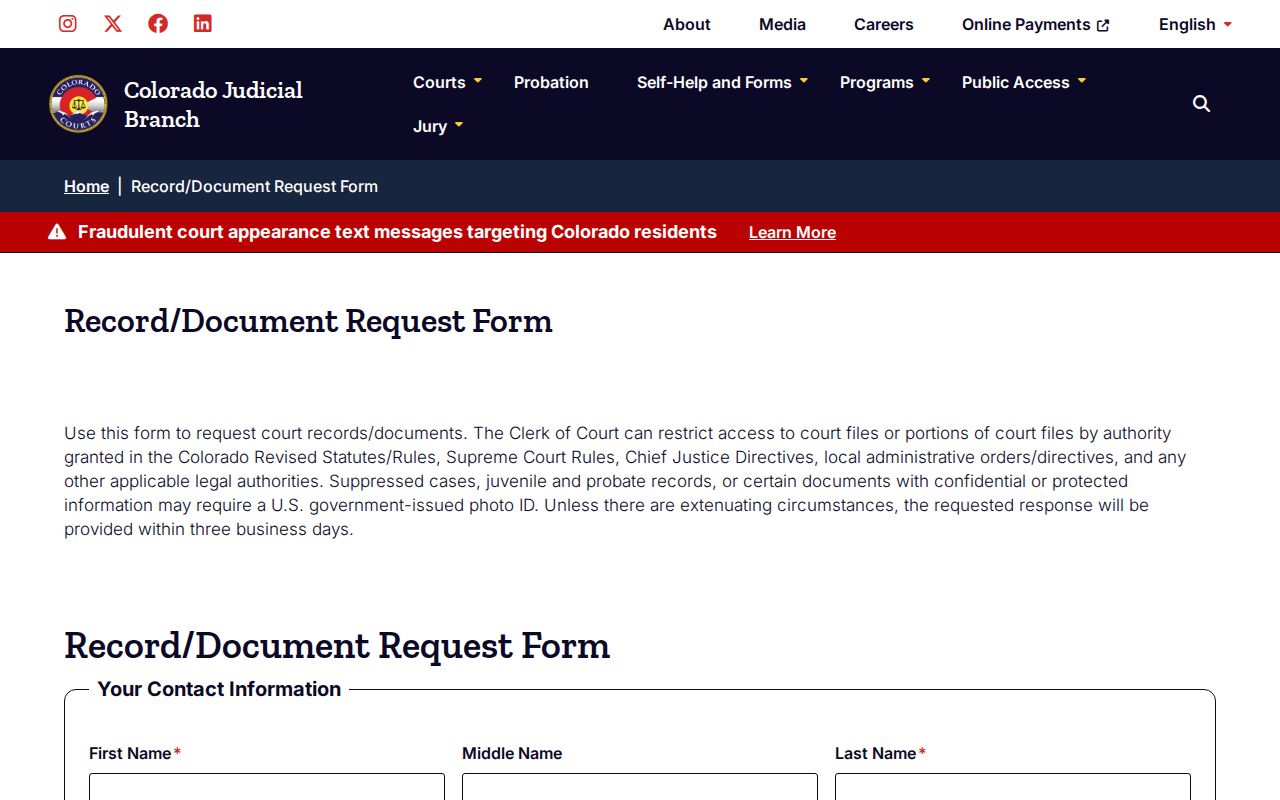
The form route is useful when a calendar line is not enough. The image represents a request channel, not proof that a particular person has a case.
| Court search field | What to enter or preserve |
|---|---|
| County and courthouse | Select Boulder county 7 and the courthouse tied to the case. |
| Case year, class, and sequence | Use the four-digit year, case class, and sequence after a name lead appears. |
| Party | Choose Individual or Business, then enter first, last, or business name. |
| Date range or specified date | Narrow a hearing calendar by preset range or exact date. |
| Attorney search | Search by attorney name or bar number when that field is known. |
| Result fields | Preserve party display, case number, hearing type, date, time, duration, location, appearance, and courtroom. |
| Sample docket field | What the result actually shows |
|---|---|
| Party or name display | The name exposed by the calendar; it is not proof of a unique person. |
| Case number | The year and sequence that anchor a clerk or request-form search. |
| Hearing details | Hearing type, date, time, duration, appearance mode, location, and courtroom. |
| Search actions | Export Results and Printable Version controls, with filters that can be changed. |
| Restricted material | Pleadings, exhibits, full case history, sealed, juvenile, and protected material may require the custodian. |
The request form asks for the requester’s first, middle, and last name, business if any, email, phone, address lines, state, city, ZIP, case number, case type, year filed, county, party information, primary party date of birth if known, and other identifying information. It offers document choices for family, criminal, civil, probate, and other records, including a register of action and certified or exemplified copies.
Fees documented on the form include $0.25 per page, a maximum of $15 for parties or attorneys and no maximum for non-parties, a $25 transcript of judgment, a $20 certificate of satisfaction, $20 per certified or exemplified document, a $5 name search, offsite retrieval at actual cost, and research or redaction at $30 per hour after the first hour. The response target is 3 business days. Restricted, juvenile, probate, or protected records may require government ID.
Verify One Boulder Resident Step by Step
A careful resident lookup keeps the same person attached to every step. Save the spelling used by each system, including a middle initial, suffix, maiden or married name, trust name, or OCR variation. An address, birth year, parcel, case number, license number, or cemetery location is stronger than a city name alone.
- Anchor the starting identity. Run GoVote with first, last, ZIP, and full birthday, or begin with a known parcel, exact address, case year, or family date.
- Check the property connection. Search the Boulder Assessor by owner name, address, street, subdivision, account, parcel, or S-T-R. Save the account, parcel, situs, mailing address, tax year, and legal-description summary separately.
- Test the recorded trail. Search Boulder PublicSearch by Party Names, Grantor, Grantee, document type, legal description, reception number, book, page, or OCR. Preserve the Reception Number, recorded date, document type, parties, references, and watermarked image status.
- Compare the court lead. Search county 7 by party, case year, class, sequence, date, or attorney. Do not treat a hearing line as a disposition; obtain the clerk-held document when the result matters.
- Use a second category. Confirm a family event with the proper vital custodian, a professional connection with DORA, a business relation with SOS, or a past address with Carnegie, BGS, a newspaper, or a cemetery record.
- Docket
- A court index or calendar entry that places a case, party, or hearing in a court system. It is not automatically the full file.
- Index versus image
- An index is searchable descriptive data. An image is the scanned instrument or filing, and access may be watermarked, restricted, or fee based.
- Certified copy
- A custodian-issued copy with a certification that identifies it as an official copy for an authorized use.
- Grantor and grantee
- The grantor transfers or conveys an interest; the grantee receives it in the recorded instrument. Neither label proves who lived at the parcel.
Boulder Vital Records Stay Confidential
C.R.S. §25-2-117 is the starting point for Colorado birth, death, adoption, marriage, and divorce records. These records are not an unrestricted online resident index. Certified access depends on a qualifying relationship, legal authority, or direct and tangible interest, with identification and proof when the custodian requires them. No verified blanket genealogy opening period was located, so an age-based assumption should not replace the county or state eligibility rule.
The Boulder County death-certificate route identifies the local scope and request path.
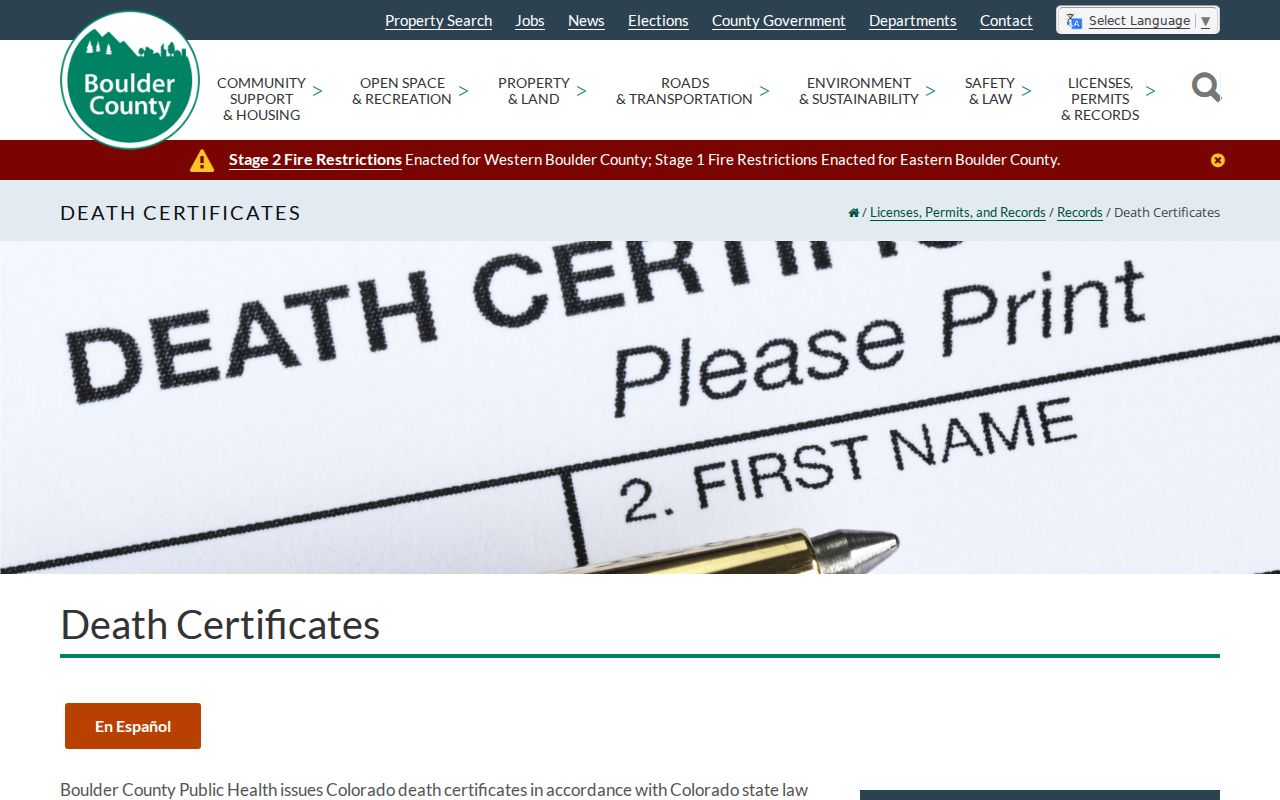
The county page covers Boulder County deaths from 1901 to the present and lists qualifying relatives, legal representatives, probate participants, and genealogists with the required credentials or direct and tangible interest.
Birth access covers Colorado-born births from 1904 to the present through Boulder and Longmont public-health counters. The current web fee is $25 for the first copy and $20 for each additional copy in the same order. Birth and death applications ask for the subject, applicant identity and contact details, relationship or eligibility, reason, identification, signature, payment, and delivery or pickup choice. The county accepts one primary ID or two secondary IDs under its current identification rules. Mail and counter channels remain available.
The Clerk and Recorder handles marriage and civil-union licenses and recorded certificates. Application and recording are $30, a certified marriage copy is $1.25, and the license is valid for 35 days. The recorder portal has a Marriage department with applicants, application, recorded and marriage dates, license number, book and page, and document number fields, though recent licenses may lag the index. A Boulder resident lookup should treat a marriage result as a dated record, and a divorce decree belongs to the Colorado district court, so use the docket and court request form rather than a vital-record search.
The Colorado Department of Public Health and Environment vital-records guidance separates state ordering routes from county custody.
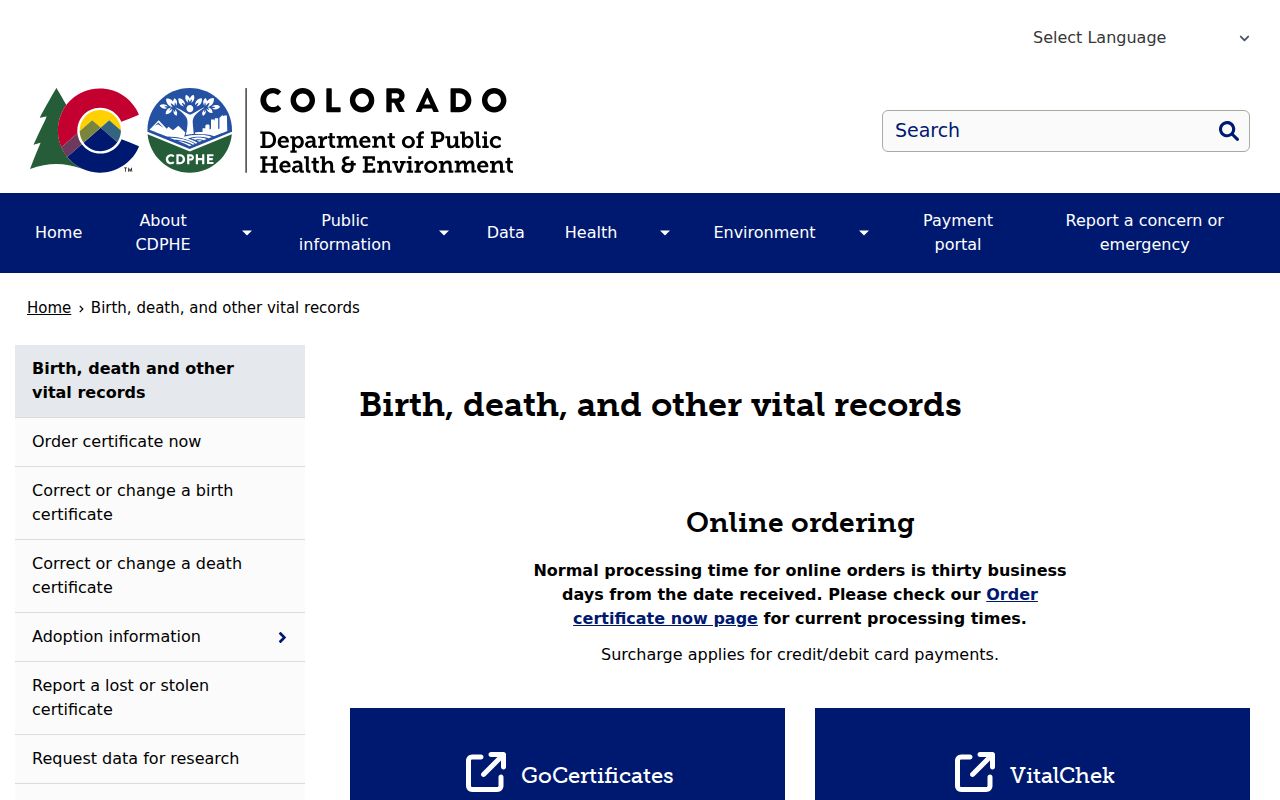
CDPHE is the state route for statewide certificates and historical guidance. Mail requests, county counters, state orders, Carnegie obituary work, newspapers, cemetery sources, and State Archives finding aids can establish an event without making a modern certificate public.
Boulder Name Checks and Registry Limits
The Colorado Bureau of Investigation ICHC is a one-person, name-based Colorado criminal-history search. The inspected service displayed $6 per result and no notarization requirement. Sealed, juvenile, and other excluded classes do not appear, so a clear or missing result is not a complete life history. Use the official result as a lead and keep the search tied to a lawful personal reason.
The Colorado name-based CBI search shows the state’s one-person route.
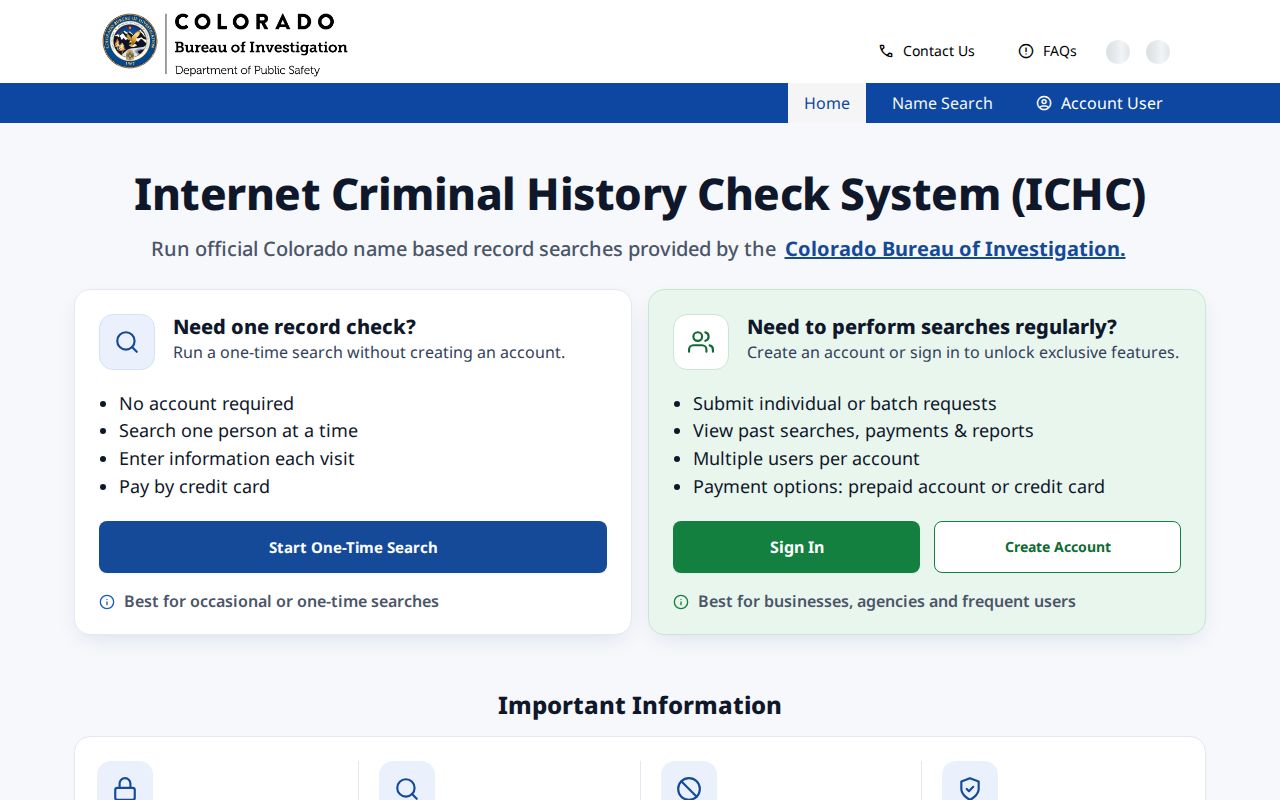
The image shows a name check interface, not a guarantee that a person with the same name is the person being sought. A Boulder resident lookup should preserve the result date, spelling, and scope instead of turning a name match into a conclusion.
Colorado’s public sex-offender registry has its own limits. Not all registrants are posted. The public list generally excludes misdemeanor sex offenses and juvenile adjudications, and the registry warns against publication, pecuniary gain, harassment, or misuse. Use the public search only for the safety and awareness purpose permitted by the registry’s instructions, and do not infer that a non-match disproves a past event.
The Colorado sex-offender registry advanced search is the official public route.
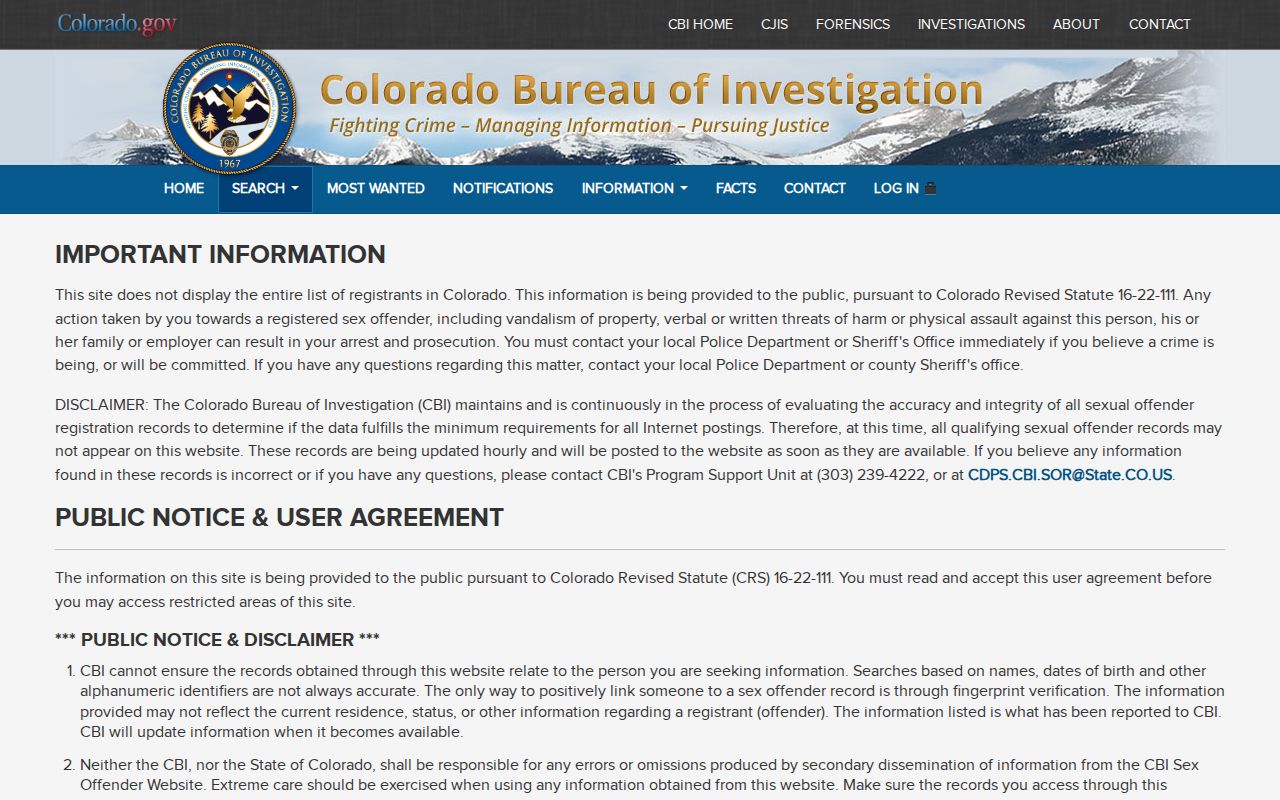
The registry image belongs with its use restrictions. It should not be copied into a personal roster or used to label a person from a name alone.
Boulder Heir and Adoption Paths
An heir question needs a probate trail, not a surname guess. The court request form lists probate choices such as Letters, Will, Trust, Application, Petition, Closing, Claims, and Date of Death. Start with the docket or register of action, then ask the Combined Court clerk for the permitted filing. Pair that result with a recorder deed, obituary, cemetery entry, or newspaper notice, and keep the case number with each conclusion.
Colorado’s official adoption routes include the Confidential Intermediary process and the Voluntary Adoption Registry. A court-appointed Confidential Intermediary may review sealed files under an order, search for the person, and contact that person, but contact information is exchanged only after written consent from both parties is filed with the court. The intermediary cannot simply release a sealed file. The registry is a consent-based path, not an open name directory. CDPHE and Colorado Department of Human Services instructions control eligibility and sequence.
For a former classmate or relative, Carnegie staff can suggest yearbooks and pair them with the 1901 to 1911 local directory indexes, NARA’s 1926, 1928, 1930, and 1932 Boulder-area directories, newspaper alumni notices, and University of Colorado collections. A complete Boulder yearbook inventory was not located, so ask the local-history desk rather than treating a missing catalog result as proof that a volume does not exist.
Boulder Businesses and License Records
Public business and license filings can confirm an affiliation without proving a person’s home address. Colorado Secretary of State business search supports business name, trademark, trade name, ID number, and document number. Search the entity and trade-name path, then preserve the entity ID, status, filing date, and only the address fields exposed by the particular result. The filing screen had a processed-through date in the inspected snapshot, so current status and dates should be checked again.
DORA MyLicense uses Profession, First or Middle Name, License Type, Last Name, License Number, and License Status fields, with a separate facility route and wildcard support after a partial term. It is a current license database, not a guaranteed historical record. Boulder’s city liquor ArcGIS layer can add location ID, location, permit, status, trade name, license type, and geometry. Use the license or entity ID as the bridge, then verify the filing date and custodian before connecting two records.
A Boulder resident lookup that reaches a business or credential should stay focused on the public affiliation itself. A trade name, recorded instrument, or license layer is not a substitute for a person match.
Carnegie Clues for Boulder Residents
Carnegie Local History joins directories, newspapers, obituary indexes, cemetery and mortuary sources, maps, oral histories, photographs, and municipal manuscripts. The room is noncirculating, and appointments or in-person inspection may be needed. The Boulder Genealogical Society adds publications such as the 1883 directory, Boulder County marriages from 1860 to 1900, and Daily Camera obituary indexes for 1960 to 1969 and 1970 to 1974.
A dated newspaper page can connect a name to a funeral, civic group, business, property notice, or former address. Columbia Cemetery adds burial location and source crosswalks, but its history includes lost maps and “Section X” entries for unknown locations. The glossary’s BCD, BCC, and AHG abbreviations point to different source types. A cemetery no-result is therefore a prompt to check the eight-volume history, mortuary books, burial applications, and newspapers.
The city’s manuscript collections add a distinctive clue: a 1875 to 1893 cash book contains dog-license entries alongside taxes, fines, shows, concerts, and liquor or saloon receipts. It is not a web roster, but it can place a historical name in Boulder when a directory year is missing. For the historical shelf and directory indexes, use the Boulder city directory collections as the next research step.
Limits on a Boulder Resident Lookup
Privacy rules create real gaps. Colorado’s Address Confidentiality Program gives eligible survivors a substitute address and mail-forwarding protection. Protected-voter options are coordinated with the county clerk and elections office. The Colorado Privacy Act does not remove an underlying government record, and DMV-derived personal information is restricted by the federal Driver’s Privacy Protection Act. Court sealing, juvenile rules, vital eligibility, and restricted recorded documents also limit what a search can show.
If a result is wrong, take the correction to the custodian that created it: the Assessor for a parcel field, Elections for registration data, the Recorder for an index or image issue, the court clerk for a docket or filing, or Public Health for a vital certificate. For a county-held record with no ordinary portal, the Boulder County CORA route can identify the request channel, but CORA does not override a confidentiality statute or protected-record rule. Keep the request narrow and state the record description, date, and known identifier.
Lawful personal use. A Boulder resident lookup is appropriate for family history, reconnecting, civic record research, correcting a source, or personal safety awareness. Do not use identifying information to stalk, harass, intimidate, or harm anyone, and do not publish a private person’s contact details.