
Boulder’s City Directory Collection Map
Boulder’s historical directory trail is a set of verified pieces, not a single uninterrupted publisher run. The strongest local evidence begins with the 1871 Rocky Mountain directory and Colorado gazetteer, edited by S.S. Wallihan and T.O. Bigney, then moves through Ella M. Travis indexes, catalog references, and National Archives microfilm. A catalog year is useful, but it is not proof that every volume or page survives. The table keeps the known runs beside their real access route and marks where a shelf check is still needed.
| Collection | Years | Where Held | Access |
|---|---|---|---|
| Rocky Mountain directory and Colorado gazetteer | 1871 | FamilySearch catalog and affiliate-library route | Catalog, microfilm, or affiliate access |
| Boulder County directory indexes | 1892-1898; 1904 | Carnegie manuscript and digital collections | Digital viewer and library copies |
| Boulder City directory indexes | 1901-1903; 1905-1908; 1911 | Carnegie, Calls 997-2-2 and 997-2-4 | Digitized indexes and in-person help |
| Local catalog directory references | 1906-07 through 1974 references | Carnegie shelves and local-history catalog | Ask staff to confirm exact volume |
| NARA Boulder-area city directories | 1926; 1928; 1930; 1932 | National Archives microfilm facilities | Microfilm research; NARA does not sell it |
| Reverse or criss-cross sections | Some post-1910 volumes | Carnegie shelf question and CU metadata | Presence in a complete Boulder run unverified |
The local record does not verify a complete commercial series, a final printed year, or a publisher sequence. It also does not establish a full telephone-book, yearbook, or reverse-directory run. NARA’s 1926, 1928, 1930, and 1932 reels include nearby communities such as Longmont, Louisville, Lafayette, Nederland, Superior, and Ward, so a name may fall outside the city line while still belonging to the Boulder research question. Preserve the place label printed in each volume before treating a hit as a Boulder match.
Carnegie’s Boulder Directory Shelf
Carnegie Local History is the practical starting point for a Boulder city directory question. The room is at 1125 Pine Street. Walk-in hours are Thursday and Saturday from 12:00 to 5:00, with appointments available at other times. Materials are noncirculating, so plan to read them in the room or ask what can be copied. The collection reaches beyond directories to photographs, oral histories, local maps, church histories, cemetery and mortuary sources, and Boulder newspapers on microfilm.
Send a focused name, date, era, place, and possible source to AskCarnegie@boulderlibrary.org. Staff research can run for up to one hour on a topic. The local-history research policy gives the copy rules: the first ten copies are free, then single-sided black-and-white copies cost $0.10 and color copies cost $0.20. Up to ten copies or scans can be mailed or emailed; larger requests are handled in person. The Boulder Genealogical Society research service also works at Carnegie for $10 per hour, plus copies, postage, and parking, through its genealogist mail route.
The Carnegie Local History collection page shows the room's role as a bridge between a name index and the source volume.
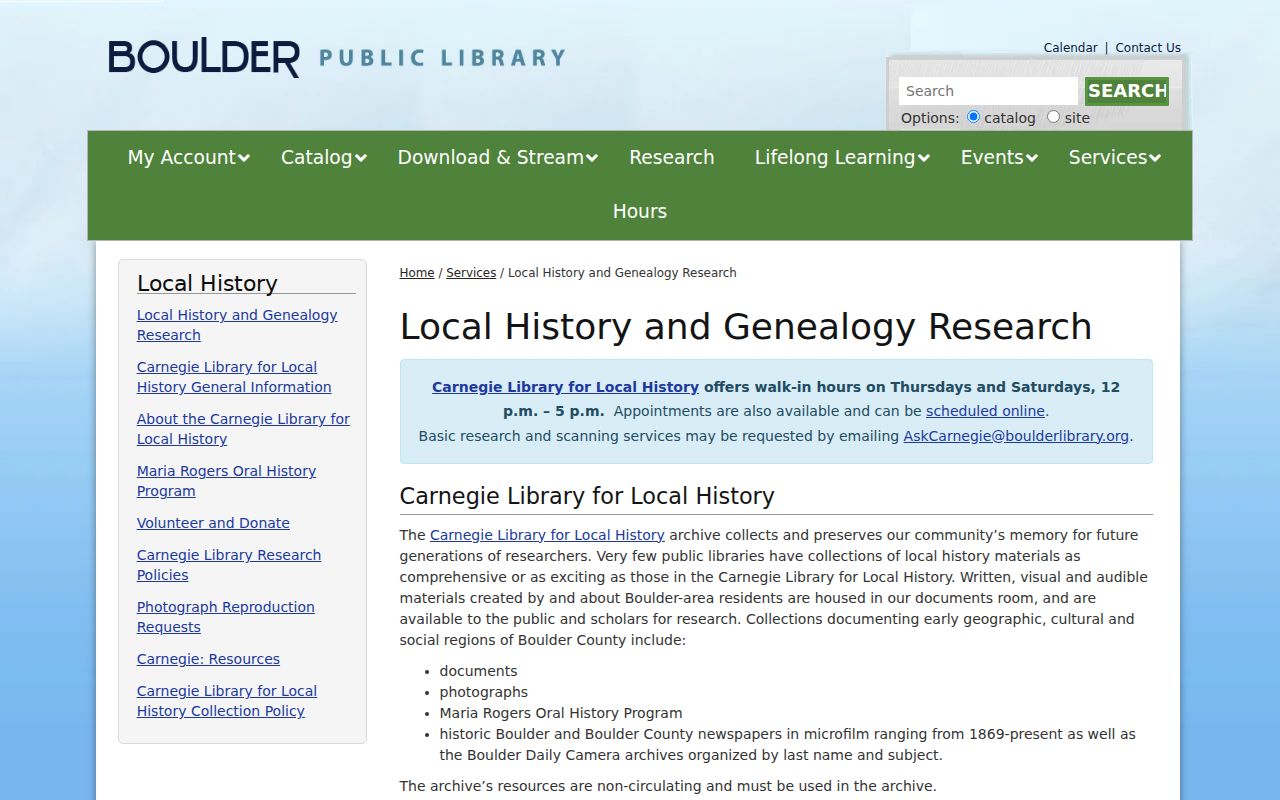
A librarian can help identify a call number, but a digital catalog entry does not guarantee that a complete printed run is on the shelf.
Ella Travis Boulder Directory Indexes
Ella M. Travis prepared the local indexes that make several early Boulder city directory years reachable by name. Call 997-2-1 covers Boulder County entries from 1892-1898, while Call 997-2-2 holds Boulder city indexes for 1901-1903. Call 997-2-3 covers the 1904 county volume, with Boulder, Lafayette, Longmont, and Louisville entries. Call 997-2-4 covers the city indexes for 1905-1908 and 1911. The index maker is verified; the original publisher for these volumes is not.
An index points to a person or business and often supplies a route to the address page, but it is not the same object as the published directory. Keep the call number, year, printed spelling, and place together. The digitized pages can support an initial search, while Carnegie hard copies and staff help remain the fallback when an image is incomplete or a notation is hard to read.
The digitized Ella M. Travis directory-index collection provides the clearest online entry point for the early index layer.
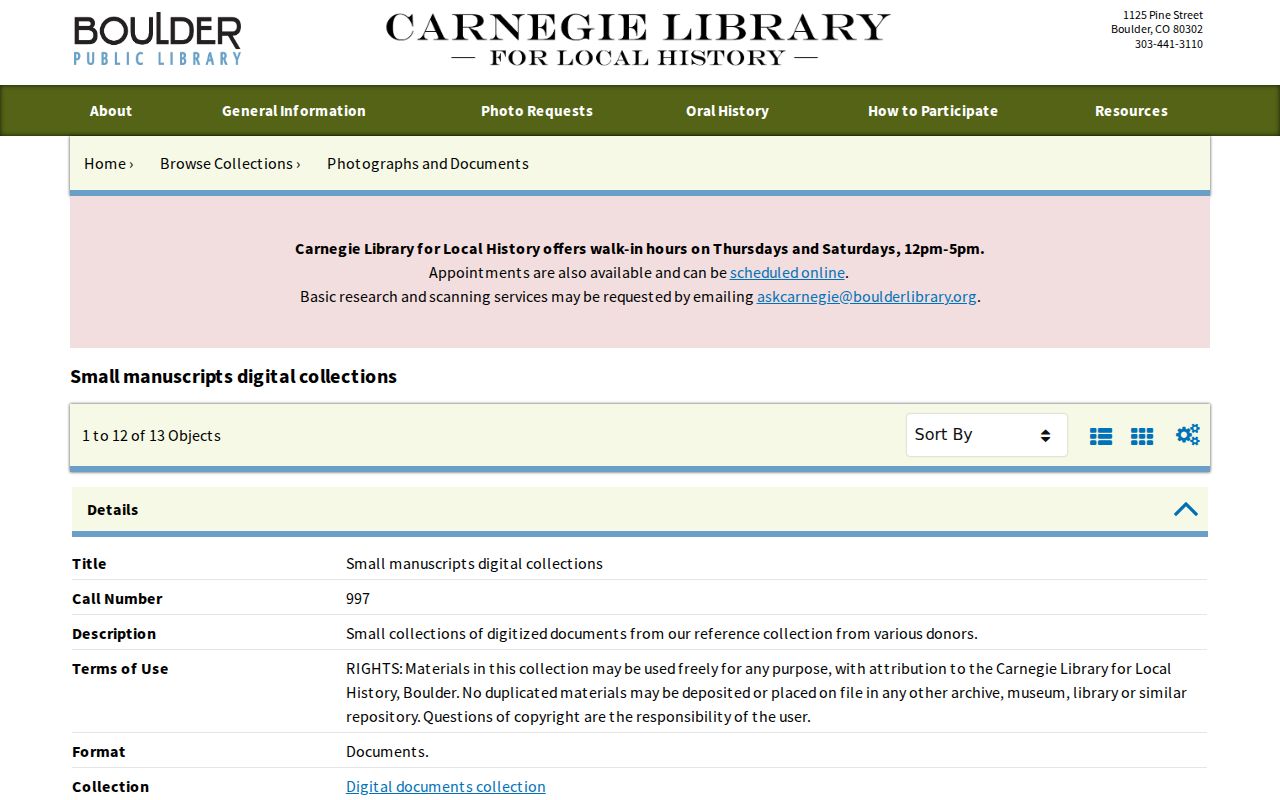
Use the digital index to form a lead, then cite the manuscript call number or shelf copy that supports the final family-history claim.
How a Boulder City Directory Entry Reads
A Boulder city directory entry is a dated snapshot, not a current resident record. The University of Colorado directory metadata describes a normal format that starts with a name, then may add a spouse, occupation, business address, residence, classified business entry, or municipal information. Local examples also show how a person or firm can be followed across years when the name, role, and address are preserved exactly.
| Name | Printed person or business name, including a normalized index form when supplied |
|---|---|
| Year or volume | The exact directory year or catalog reference for the entry |
| Occupation or business | Role, trade, firm name, manager line, or classified-business placement |
| Address | Residence or business street address, kept in its printed form |
| Family and status marks | Spouse or family notation, ownership or household-status mark, widow notation, or abbreviation |
| Street-order section | A reverse or criss-cross portion when the volume includes one |
Do not silently expand an initial, modernize a street name, or turn an owner mark into proof that a whole household lived there. The exact Boulder abbreviation key was not visible in the catalog snippets reviewed, so photograph or transcribe the key before reading a mark as a relationship or status.
- Criss-cross directory
- A street-order section that lets an address lead back to names, when that volume has the section.
- Householder index
- An index organized around the head of a household or principal entry, useful for starting a name search.
- Abbreviation key
- The volume's legend for short forms and marks; it should be checked before any notation is interpreted.
Boulder Reverse and Criss-Cross Directories
Address-to-name searching is the most tempting part of an old city directory, yet the Boulder evidence needs a careful qualifier. A complete digitized reverse run was not located. University of Colorado metadata says some volumes after 1910 support reverse street searching, but its strongest runs are for Leadville, Colorado Springs, and Denver. That makes the format a useful method, not proof that every Boulder year has a street section.
Carnegie's shelf and catalog can answer the missing question. Ask whether the desired year has a street-order section, a householder index, or only a name index. Local catalog examples show the value of a cross-year check: Crystal Ice and Consumers Ice appear in 1906-07, 1908, 1911, 1913, 1916, 1918, and 1921 with manager and address fields. Another sequence follows Allen Feaster from a factory-worker entry in 1946 to Feaster & Harris in 1949 and Cardinal Industries in 1951 and 1953 as the address and business form changed.
A reverse result is a dated clue. Confirm it with the name page, a newspaper notice, a census image, or a municipal record before treating the address as a household match.
Tracing Family Through Boulder City Directories
Use a Boulder city directory as a chain of dated observations. Begin with the most certain name or address, keep the original spelling, and resist the urge to fill a missing year from a nearby city. The local sequence is uneven, so the strength of the trail comes from matching several small fields rather than assuming that a familiar surname is the same person.
- Start with the nearest confirmed year and record the name, address, occupation or business, spouse notation, and any mark beside the entry.
- Move forward and backward through the verified local years, keeping a separate note for each printed form and place label.
- Check the street-order or criss-cross portion when the volume has one, then compare the address with the name index.
- Pair the directory snapshot with the nearest census, including the 1885 Colorado state census and released federal schedules.
- Close a gap with a dated newspaper or obituary page, a cemetery source, a permit, or a city ledger.
A disappearance can mean a move, death, a business change, an omitted entry, or a gap in the surviving run. Census geography can also shift the apparent trail because the 1930 NARA reel includes nearby communities, not just the modern city line. When a historical name needs a present-day identity check, use a Boulder resident lookup as a separate verification task, not as a replacement for the dated source.
Boulder Directory Census Pairing
Directory years and census years answer different questions. The directory is a publication snapshot with address and occupation clues. The census is an enumeration snapshot with household relationships, age, and place context. Boulder has an 1885 Colorado state-census collection through FamilySearch and NARA, while the federal schedules released under the 72-year rule currently reach through 1950. The NARA 1930 city-directory guide identifies Boulder enumeration districts 7-1 through 7-43 in multiple segments.
- 1871 to 1885: use the Rocky Mountain directory and Colorado state census as separate early clues, then inspect the image when an index is unclear.
- 1892-1911: pair the Ella M. Travis county and city indexes with the nearest available census and a local notice.
- 1926-1932: compare the NARA city-directory reels with the federal census and check nearby community labels.
- Later years: use released census images where available and leave unreleased or unverified years blank rather than guessing.
Compare street, county, occupation, age, and family composition together. One shared name is weak evidence. A same-address result with the same spouse or business is stronger, but every link in the chain still needs its own citation.
Boulder Newspapers and Cemetery Cross-Checks
Newspapers can bridge the years that a city directory leaves thin. Carnegie describes broad Boulder and Boulder County newspaper holdings from 1869 to the present. The Daily Camera microfilm runs from June 1891 to the current collection, with a noted June 2009 gap. Boulder Genealogical Society obituary indexes cover 1859-1925 and 1960 to the present. Treat an index as a lead, then capture the exact page, date, title, and wording from the scan or microfilm.
The Boulder local newspaper collection connects a name with a funeral place, family relationship, business, civic group, or property notice.
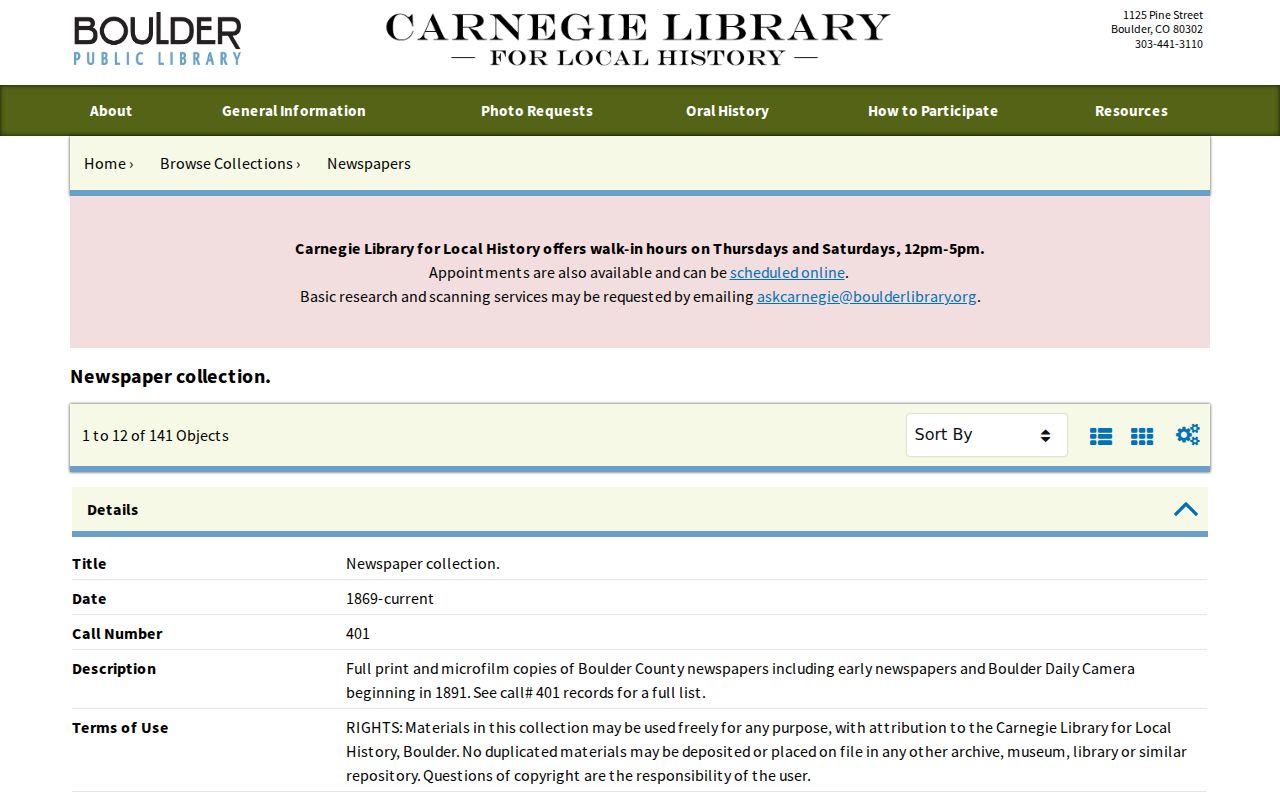
A dated newspaper page can explain why a directory entry changed, but it should not be treated as a substitute for the directory scan.
Columbia Cemetery adds a second cross-check. The city index covers first name, last name, or cemetery location, while the broader history draws on directories, county census series, mortuary books, burial applications, recorder material, estate files, newspapers, and family histories. Nearly 6,500 people are interred on 10.5 acres. Section X entries, lost maps, and an eight-volume history explain why a blank map result is not decisive.
The Columbia Cemetery history and burial index is especially useful when a former Boulder household ends in a death or funeral clue.
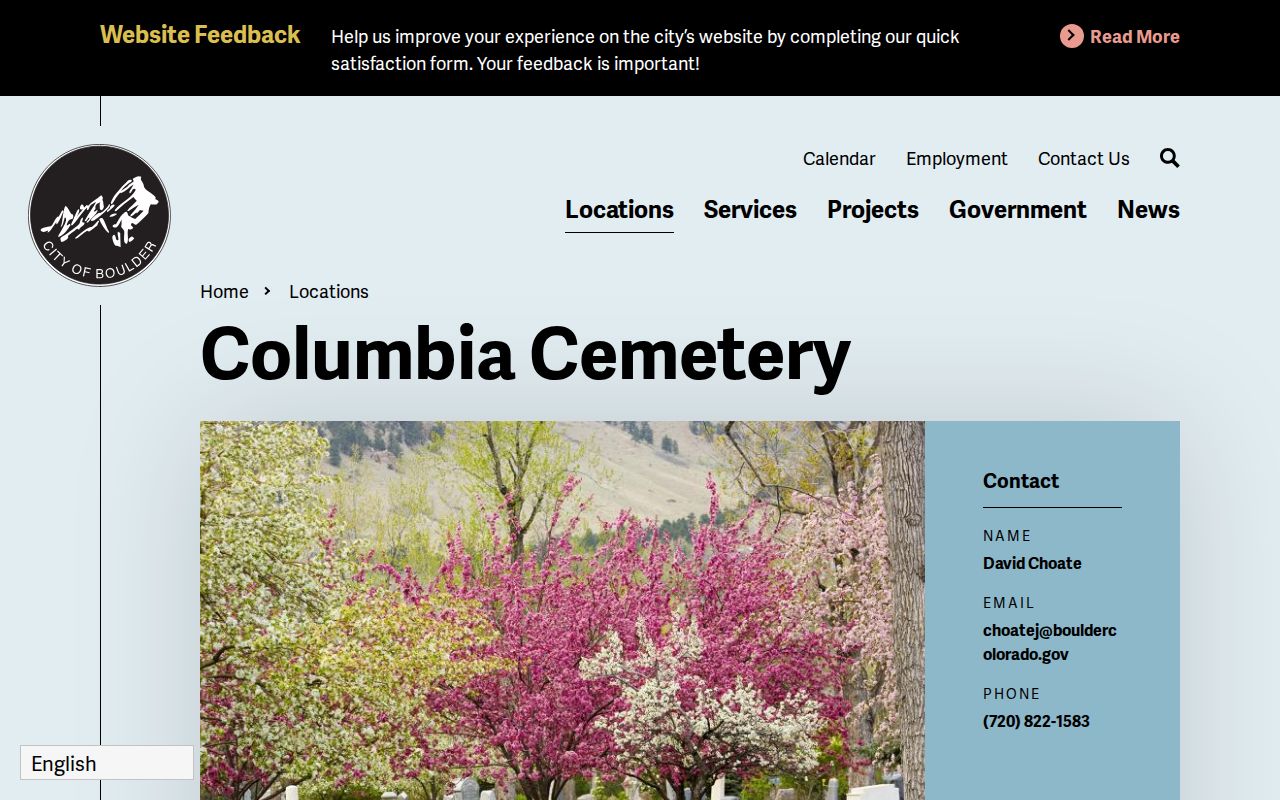
Use the cemetery source abbreviation notes to locate the next record, not to claim that every burial source is complete.
Boulder Sanborn Maps and City Ledgers
Sanborn maps provide the physical layer behind a Boulder city directory address. The Carnegie collection covers 1883-1931 and can show a building footprint, size, construction, windows, doors, street width, property lines, use, and house or block numbers. The maps are not resident indexes. They help identify a house or business when a printed address has shifted, and they can show whether a structure changed between two dated sheets.
Boulder municipal manuscripts add name-bearing context. The collection includes a cash book from 1875-1893, a city property record from 1874-1916 with a grantor index and copies of deeds to the city, a building-permit ledger reaching 1873-1967, a separate April 1911-May 1927 permit ledger, and a Columbia Cemetery ledger from 1913-1954. The cash book even contains dog-license entries alongside taxes, fines, shows, and liquor or saloon receipts. These are manuscript holdings, not a single online lookup.
The Boulder Sanborn map collection can supply a block and house-number bridge before the directory search is repeated.
Boulder Directory Gaps to Verify
Boulder’s record history includes a warning about missing context. The original county courthouse, built in 1882, burned on February 9, 1932, and the current courthouse followed in 1933. The county courthouse history does not identify which resident, deed, or court record groups were lost or rebuilt. The safe conclusion is that a gap needs a custodian check, not that a named person was absent from Boulder.
- 1871: the Rocky Mountain directory and Colorado gazetteer places Boulder among Colorado towns.
- 1892-1911: Ella M. Travis county and city indexes form the strongest digitized local index layer.
- 1926-1932: NARA microfilm adds Boulder-area directory years and nearby communities.
- Through 1974: Carnegie catalog references continue, but a complete run and publisher sequence remain unverified.
- Unresolved: complete reverse, telephone, yearbook, title-page, and abbreviation-key coverage needs an in-person shelf check.
Ask Carnegie for the exact shelf year, use the digitized index where it exists, and cite NARA or FamilySearch only for the collection actually inspected. Once a historical address is tied to a modern parcel, the Boulder street directory workflow can handle the present address record without rewriting the historical evidence.